Showing posts with label Vulcan. Show all posts
Sunday, November 3, 2013
Searching for Soval
Some of you know that I have been producing a Star Trek movie called "Axanar". If you are on Facebook, you can find our page here:
https://www.facebook.com/StarTrekAxanar
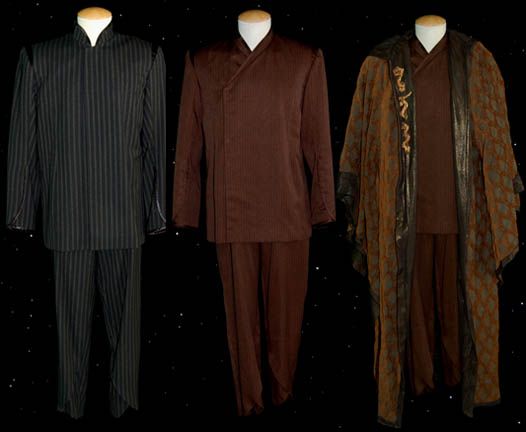
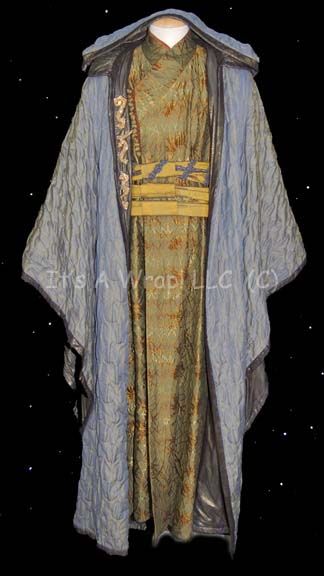
Well, Gary Graham will be reprising his role of Ambassador Soval in Axanar, and I am starting to look for costuming for him. So do any of you have either of these two lots, sold by IAW?
If so, please email me at alec@propworx.com
THANKS!
Alec
Thursday, April 18, 2013
The Kolinahr Museum Launches
Jordino Delos Santos is maybe the biggest collector of Vulcan screen used props & costumes from Star Trek. Ever since the It's A Wrap auctions in 2006-8, Jordino has been collecting, cataloging and preserving Vulcan costumes.
Now he has finally published his website that catalogs and displays high quality photography of every one of his artifacts. he has called this website "The Kolinahr Museum" and it is the best Star Trek prop & costume website I have seen.
Jordino displays everything in a "museum" format, and the text supports that you are looking at a collection from some futuristic museum. He even has a mission statement:
“ The
Mission of The Kolinahr Museum is to collect, preserve, study, exhibit,
and stimulate the appreciation for and advance the knowledge of Vulcan
art and artifice, that collectively represent the broadest spectrum
of Vulcan achievement and culture.”
So make sure you add The Kolinahr Museum to your list of must see Star Trek prop & costume websites!
Alec
Monday, August 23, 2010
A new Star Trek blog launches

While I am writing my Star Trek auction summary, I thought I would tell you all about Vulcanology, a new Star Trek blog focused on, well, Vulcans.
Launched by Star Trek Prop Forum member Scott Lucas Williams, it focuses on your favorite pointy eared aliens.
Check it out!
Alec
Wednesday, May 5, 2010
Wah Chang and the Vulcan Lyre
Another great article by Scott Lukas Williams
Wah Chang is one of the great unsung heroes of Star Trek. Born in 1917, Chang showed an immense capacity for creative thinking and problem solving from a young age. By the time he was seven years old, Chang was already experimenting at creating art in various mediums and those around him encouraged him to continue. In the 1930s, Chang began to experiment with puppets and stop-motion photography. He worked for Disney creating wooden puppets for the animators to study as they worked on Pinocchio and Fantasia. From there, he went on to design toys and puppets, some of which were used for commercials. In 1957, Chang and two friends formed a company called Project Unlimited, Inc. Together, they created costumes, props and special effects for films and television. Most notably, they did extensive work on The Time Machine for which they would win an Oscar. Chang co-designed the elaborate headdresses for Elizabeth Taylor in Cleopatra and went on to do a great body of work for producer Bob Justman on The Outer Limits.
Chang’s association with Justman led to work on the first Star Trek pilot in 1964. He designed the make-up for the Talosians and also the first phaser. Though uncredited for his work, Chang went on to design many of the most famous props and creatures for TOS, including: the Communicator, the Tricorder, the Romulan Bird of Prey, Romulan helmets, the Salt Vampire, the Gorn, Balok, the Tribbles and finally, Mr. Spock’s Vulcan Lyre.
The Vulcan Lyre (also sometimes called a harp or lute) made its first appearance in the early episode “Charlie X.” It made several other appearances in TOS (“The Conscience of the King,” “Amok Time” and “The Way to Eden”). Chang’s original prop was made of a single piece of solid wood and featured a filament strung up and down multiple times to give the impression of many strings. It was not a functional instrument. After TOS, it was painted black and featured in an episode of Mork and Mindy (many Star Trek props and costumes found their way on to this show).
The next time we would see a Vulcan Lyre was in the 1988 TNG episode “When the Bough Breaks.” It can be seen behind Melian (Paul Lambert) the Aldean musician as he instructs Katie (Jandi Swanson). Mike Okuda borrowed this replica for the set from Gene Roddenberry who kept it in his office.
In 1989 Paramount engaged the services of Dominick Giovanniello at Creative Guitar Studios in San Diego to create licensed replicas of the prop. Unfortunately, the company only held the license for about two years before going out of business but in that time they created at least 25 replica lyres. These are working instruments that make sound when plucked though all the knobs are non-functional. Instead of being solid, they are hollow which allows for the strings to vibrate and create sound. They are strung with 12 wire-wound steel electric guitar strings. Besides only having 12 strings there are a couple of other differences between this replica and Chang’s original. First is that the bottom corner is rounded where the original is pointed. Also, on the original, where the neck meets the body, the neck is thicker than the body. Because these replicas are hollow they have a thin piece of wood on the front and back which makes the body thicker than the neck. These images come from one of Giovanniello’s lyres when it was sold on eBay.
In Star Trek V: The Final Frontier (1989) Spock plays his Vulcan Lyre around the campfire with Kirk and McCoy in the final scene. Based on the appearance of the bridge and the number of strings it seems this was one of the Creative Guitar Studios replicas. However, I have not been able to confirm this.
One of Giovanniello’s lyres was purchased by Doug Drexler who loaned it to the Star Trek prop department for use on ST: DS9 and ST: Voyager. Drexler’s replica was used in the ST: DS9 episode “Through the Looking Glass.” Intendant Kira Nerys (Nana Visitor) had several Vulcan slaves in the Mirror Universe. The lyre can be seen in her quarters in this episode.
Drexler’s replica was also used for two appearances on ST: Voyager where it belonged to Tuvok (“Persistance of Vision” and “Riddles”). Following its appearances on ST: Voyager, Drexler retrieved his lyre from Property Master Alan Simms. It was later sold by Propworx to Star Trek Prop and Costume Forum member, Donna Sakaida.
When the Star Trek Experience opened in Las Vegas in 1998 it included a museum of props and costumes. One of Giovanniello’s replicas was modified for use in this display. This version has 17 strings rather than 12 and the bridge has been altered so the strings originate under the round disc as they did on Chang's original. You can see from the blonde wood that these replicas did vary somewhat.
Also for the Experience, Paramount commissioned HMS Creative Productions to create replicas that were offered for sale in the Admiral’s Store. HMS had a long relationship with Paramount, frequently helping to create props for the Star Trek films and television series. They were given a tracing of a lyre and some screenshots from which to develop a replica.
Later, Roddenberry.com hired HMS to create replicas to sell online. Now experts, HMS craft replicas that are almost dead ringers for Chang’s original prop. The ones sold on Roddenberry.com feature the pointed bottom corner and thicker neck of the original. They also feature 30 strings which is more in line with the number Chang intended.
During the fifth season of ST: DS9 (1996-1997) Doug Drexler discovered a small lock-up of items that had been used on Mork and Mindy under Paramount Stage 18. Included was Chang’s original prop! No one seems to know what has become of it now. Some TOS costumes that were altered for use on Mork and Mindy were sold by Christie’s. Hopefully, someday, the original lyre will re-surface.
In 1994, Wah Chang was awarded the George Pal Memorial Award by the Academy of Science Fiction, Fantasy & Horror Films to honour his many contributions to genre filmmaking. Chang continued his creative life until he died in 2003. Towards the end of his life, he created beautiful bronzes and animal sculptures. At the time of his death, an exhibition of his work was on display at the Chinese Historical Society of America in San Francisco.
I would like to acknowledge the generous assistance of Doug Drexler, Donna Sakaida and HMS Creative Productions. Without their research it would have been impossible to compile this history.

Sunday, November 23, 2008
Vulcan Symbology and Clothing Part 1
Vulcan Symbology and Clothing
Part One: The Trinity
By Scott Williams
Widely held Vulcan philosophy and beliefs require Vulcans to attain a state of mental order and tranquility. It is a lifelong goal of most Vulcans to reach this state. To do so, they use the techniques of T'san s'at (ST: VOY "Alter Ego). T'san s'at is the intellectual deconstruction of emotions and the effects of emotions on one's actions. The process of T'san s'at can involve years of meditation, study and struggle. In attaining a goal, it is often helpful to have a physical symbol to remind one of the journey they are on.
As in most cultures, Vulcan religion and philosophy have many important symbols with diverse histories and meanings. No single symbol means the same thing to every Vulcan. However, there is a series of three symbols which appear with great consistency and across many different professional boundaries in Vulcan society. These are called Rata, Tafar and Tapan.
Usually, these symbols are worn on the chest in a vertical column. Their meanings, translated into English, are Concept (Rata), Discipline (Tafar) and Process (Tapan). According to some, a poetic form may be associated to the unity of these symbols: "Branches entwined form the tree" (http://startrekpropcollector.com/trekauctions/items/4184). This would suggest that on their own, these symbols are but pieces of a larger whole and thus incomplete unless presented together.
The concept of unity in Vulcan symbology is not unique to this Trinity. It can also be found in the Kol-Ut-Shan or IDIC (ST: VOY "Gravity"). IDIC is an acronym which stands for Infinite Diversity in Infinite Combinations. The symbol which represents IDIC consists of an organic sphere which is pierced by a triangular shape. At the intersection of the two shapes there is a beautiful gem. This suggests that when two or more diverse objects, ideals or persons come together something unique and beautiful can be created.
The IDIC symbol was used as early as the 4th century CE when it appeared on Surak's katric ark (ST: ENT "The Forge"). In that incarnation, the triangular portion was directly vertical where most later examples of the symbol have the triangular portion at an angle. To some, this has suggested a secondary meaning of the symbol as representative of Mount Seleya piercing the Vulcan sun. However, as the IDIC symbol is most often found on objects or as decoration on walls it has little bearing on our discussion of symbols and clothing. The IDIC has also taken the form of a medal and has sometimes been used as an award of merit. In these cases it is worn on the body but it has never been seen worked into the original design of clothing.
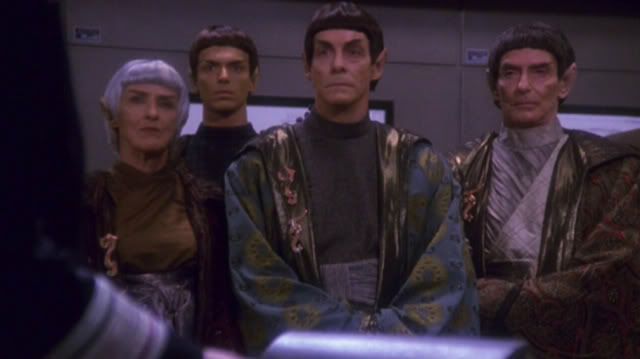
Let us return to the Trinity of Rata, Tafar and Tapan. These symbols were in use as part of Vulcan clothing as early as April 5, 2063 when the Vulcan ship T'plana-Hath landed on Earth and Vulcans made "first contact" with Humans (ST: First Contact).


In these examples from 2063, the symbols are rendered in what has come to be called Vulcan calligraphy. All the later examples below are rendered in Vulcan print script.
The symbols were in heavy use on clothing from 2151 through 2161 (ST: ENT "Broken Bow" through "These are the Voyages").

A careful examination of the images from 2063 and 2151 will reveal that it is not only the Trinity which remained in fashion during that time. The clothing worn by the commanding officer of the T'plana-Hath is nearly identical to that worn by the Vulcan to the far right in the 2151 image.
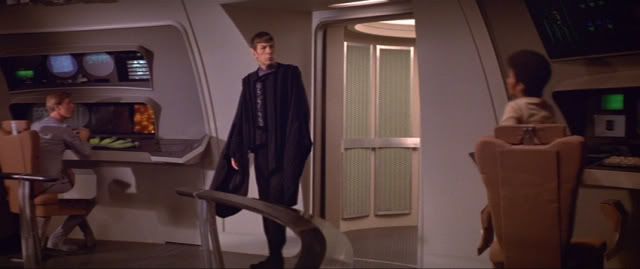
In 2272, Spock wore the Trinity as part of his robe when he re-joined the crew of the Starfleet vessel Enterprise (ST: The Motion Picture).

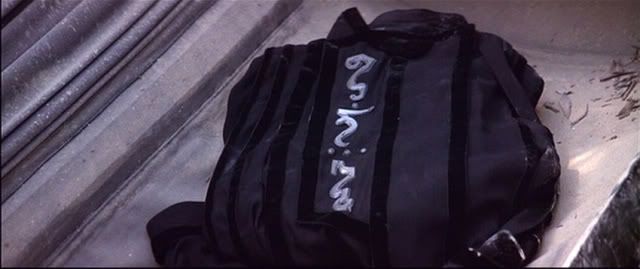
After his death in 2285, Spock was buried in this same robe (ST: The Search for Spock).

Heretofore, the individuals whom we have seen wearing these symbols have mostly been politicians: world leaders, government officials and ambassadors. A notable exception is a Dr. Strom who was seen wearing the Trinity in 2152 (ST: ENT "Stigma"). It should be noted, however, that though Strom was a medical doctor he was working for the government. At this time in his life, Spock was not a political man. However, we know that in the 2270s, Spock was attempting to attain Kolinahr. More than simply a suppression of emotions as in the T'san s'at, Kolinahr represents an actual purging of emotions; the attaining of a state where one no longer feels at all. Though Spock did not attain Kolinahr it seems likely that the concept was still important to him. We can speculate that wearing the Trinity was a reminder to him of what he hoped to attain.
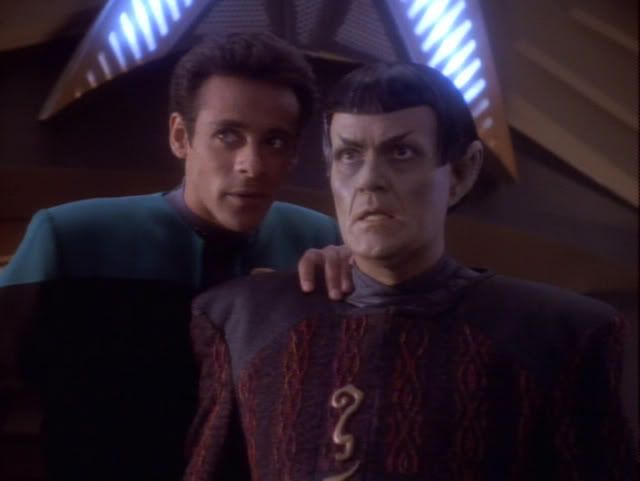
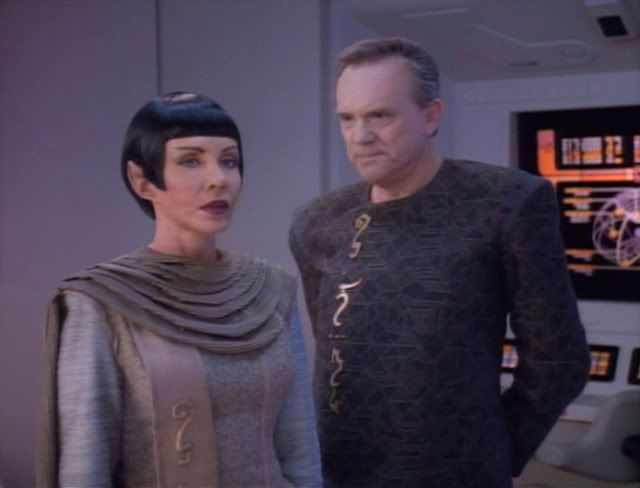
When we next see the Trinity being worn it is in 2369 by Ambassador Lojal on his visit to space station Deep Space Nine (ST: DS9 "The Forsaken").

Also in 2369, we can see the Trinity being worn by Dr. T'Pan and her husband Dr. Christopher when they visited the Starfleet vessel USS Enterprise-D (ST: TNG "Suspicions").

Clearly, by 2369 the Trinity is being worn by persons in all segments of society. Indeed, it may be possible that this was always the case and we simply have not recorded it. Regardless, it can be said with some certainty that these three symbols are important elements of Vulcan culture. Anything that is important enough to wear upon one's person must have great personal or cultural significance. That significance need not necessarily be the same for every individual. In every culture there are religious and philosophical symbols which are worn by many individuals; both lay persons and officials. To each person, they likely mean something slightly different but equally important.
This essay is to be followed by a second part which will focus more specifically on Vulcan religious symbols as they are integrated into clothing with specific emphasis on the religion surrounding Mount Seleya.
AUTHOR'S NOTE:
Very little of this essay can be considered accurate to Star Trek's "canon." The symbols I have referred to as the Trinity have never been discussed on-screen. My information regarding them comes from continuity photos as discussed in auction listings written by the folks at It's A Wrap! Since the information on these continuity photos was written by the actual Star Trek wardrobe department I have taken it as gospel but nothing that has not been discussed on screen is written in stone. Any errors are mine alone. Special thanks to everyone at The Star Trek Auction Listings Archive.
Please feel free to contact me at ScottLukasWilliams@Hotmail.com with any questions or comments.
It's A Wrap! Connections:
Ambassador Lojal's costume from ST: DS9 "The Forsaken" was sold in an IAW auction on eBay as lot #2204.
http://startrekpropcollector.com/trekauctions/items/2204
Dr. Strom's costume from ST: ENT "Stigma" was sold in an IAW auction on eBay as lot #4184.
http://startrekpropcollector.com/trekauctions/items/4184
Dr. Christopher's costume from ST: TNG "Suspicions" was sold in an IAW auction on eBay as part of lot #5820.
http://startrekpropcollector.com/trekauctions/items/5820
A Tafar pin as worn on ST: ENT was sold in an IAW auction on eBay as lot # 8600.
http://startrekpropcollector.com/trekauctions/items/8600
A Tapan pin as worn on ST: ENT is being sold in an IAW auction on eBay as lot #9558.
http://startrekpropcollector.com/trekauctions/items/9558
Part One: The Trinity
By Scott Williams
Widely held Vulcan philosophy and beliefs require Vulcans to attain a state of mental order and tranquility. It is a lifelong goal of most Vulcans to reach this state. To do so, they use the techniques of T'san s'at (ST: VOY "Alter Ego). T'san s'at is the intellectual deconstruction of emotions and the effects of emotions on one's actions. The process of T'san s'at can involve years of meditation, study and struggle. In attaining a goal, it is often helpful to have a physical symbol to remind one of the journey they are on.
As in most cultures, Vulcan religion and philosophy have many important symbols with diverse histories and meanings. No single symbol means the same thing to every Vulcan. However, there is a series of three symbols which appear with great consistency and across many different professional boundaries in Vulcan society. These are called Rata, Tafar and Tapan.
Usually, these symbols are worn on the chest in a vertical column. Their meanings, translated into English, are Concept (Rata), Discipline (Tafar) and Process (Tapan). According to some, a poetic form may be associated to the unity of these symbols: "Branches entwined form the tree" (http://startrekpropcollector.com/trekauctions/items/4184). This would suggest that on their own, these symbols are but pieces of a larger whole and thus incomplete unless presented together.
The concept of unity in Vulcan symbology is not unique to this Trinity. It can also be found in the Kol-Ut-Shan or IDIC (ST: VOY "Gravity"). IDIC is an acronym which stands for Infinite Diversity in Infinite Combinations. The symbol which represents IDIC consists of an organic sphere which is pierced by a triangular shape. At the intersection of the two shapes there is a beautiful gem. This suggests that when two or more diverse objects, ideals or persons come together something unique and beautiful can be created.
The IDIC symbol was used as early as the 4th century CE when it appeared on Surak's katric ark (ST: ENT "The Forge"). In that incarnation, the triangular portion was directly vertical where most later examples of the symbol have the triangular portion at an angle. To some, this has suggested a secondary meaning of the symbol as representative of Mount Seleya piercing the Vulcan sun. However, as the IDIC symbol is most often found on objects or as decoration on walls it has little bearing on our discussion of symbols and clothing. The IDIC has also taken the form of a medal and has sometimes been used as an award of merit. In these cases it is worn on the body but it has never been seen worked into the original design of clothing.
Let us return to the Trinity of Rata, Tafar and Tapan. These symbols were in use as part of Vulcan clothing as early as April 5, 2063 when the Vulcan ship T'plana-Hath landed on Earth and Vulcans made "first contact" with Humans (ST: First Contact).


In these examples from 2063, the symbols are rendered in what has come to be called Vulcan calligraphy. All the later examples below are rendered in Vulcan print script.
The symbols were in heavy use on clothing from 2151 through 2161 (ST: ENT "Broken Bow" through "These are the Voyages").

A careful examination of the images from 2063 and 2151 will reveal that it is not only the Trinity which remained in fashion during that time. The clothing worn by the commanding officer of the T'plana-Hath is nearly identical to that worn by the Vulcan to the far right in the 2151 image.
In 2272, Spock wore the Trinity as part of his robe when he re-joined the crew of the Starfleet vessel Enterprise (ST: The Motion Picture).

After his death in 2285, Spock was buried in this same robe (ST: The Search for Spock).

Heretofore, the individuals whom we have seen wearing these symbols have mostly been politicians: world leaders, government officials and ambassadors. A notable exception is a Dr. Strom who was seen wearing the Trinity in 2152 (ST: ENT "Stigma"). It should be noted, however, that though Strom was a medical doctor he was working for the government. At this time in his life, Spock was not a political man. However, we know that in the 2270s, Spock was attempting to attain Kolinahr. More than simply a suppression of emotions as in the T'san s'at, Kolinahr represents an actual purging of emotions; the attaining of a state where one no longer feels at all. Though Spock did not attain Kolinahr it seems likely that the concept was still important to him. We can speculate that wearing the Trinity was a reminder to him of what he hoped to attain.
When we next see the Trinity being worn it is in 2369 by Ambassador Lojal on his visit to space station Deep Space Nine (ST: DS9 "The Forsaken").

Also in 2369, we can see the Trinity being worn by Dr. T'Pan and her husband Dr. Christopher when they visited the Starfleet vessel USS Enterprise-D (ST: TNG "Suspicions").

Clearly, by 2369 the Trinity is being worn by persons in all segments of society. Indeed, it may be possible that this was always the case and we simply have not recorded it. Regardless, it can be said with some certainty that these three symbols are important elements of Vulcan culture. Anything that is important enough to wear upon one's person must have great personal or cultural significance. That significance need not necessarily be the same for every individual. In every culture there are religious and philosophical symbols which are worn by many individuals; both lay persons and officials. To each person, they likely mean something slightly different but equally important.
This essay is to be followed by a second part which will focus more specifically on Vulcan religious symbols as they are integrated into clothing with specific emphasis on the religion surrounding Mount Seleya.
AUTHOR'S NOTE:
Very little of this essay can be considered accurate to Star Trek's "canon." The symbols I have referred to as the Trinity have never been discussed on-screen. My information regarding them comes from continuity photos as discussed in auction listings written by the folks at It's A Wrap! Since the information on these continuity photos was written by the actual Star Trek wardrobe department I have taken it as gospel but nothing that has not been discussed on screen is written in stone. Any errors are mine alone. Special thanks to everyone at The Star Trek Auction Listings Archive.
Please feel free to contact me at ScottLukasWilliams@Hotmail.com with any questions or comments.
It's A Wrap! Connections:
Ambassador Lojal's costume from ST: DS9 "The Forsaken" was sold in an IAW auction on eBay as lot #2204.
http://startrekpropcollector.com/trekauctions/items/2204
Dr. Strom's costume from ST: ENT "Stigma" was sold in an IAW auction on eBay as lot #4184.
http://startrekpropcollector.com/trekauctions/items/4184
Dr. Christopher's costume from ST: TNG "Suspicions" was sold in an IAW auction on eBay as part of lot #5820.
http://startrekpropcollector.com/trekauctions/items/5820
A Tafar pin as worn on ST: ENT was sold in an IAW auction on eBay as lot # 8600.
http://startrekpropcollector.com/trekauctions/items/8600
A Tapan pin as worn on ST: ENT is being sold in an IAW auction on eBay as lot #9558.
http://startrekpropcollector.com/trekauctions/items/9558
Subscribe to:
Posts (Atom)